Learn / Official rules explained
Ball contact rules
What happens when the ball hits your body, your shirt or your paddle hand, when a double hit is legal, and when you may reach over or cross the net. Clear answers based on the current USA Pickleball rulebook.
The basic idea
In pickleball you may only play the ball with your paddle. Your body, your clothes and anything you carry are not part of your "racket," with one narrow exception for your hand. Add a few rules about hitting the ball twice and about the net, and you have most of the ball contact rules.
USA Pickleball revises the rulebook every year, and the current edition is the final word. This guide follows the 2026 edition.
When the ball hits a player
After the serve, if the ball touches you or anything you are wearing or carrying, it is a fault against you. That includes:
- Your body, arm, leg or head.
- Your shirt, hat, sunglasses or a towel on your waistband.
- Your partner, if the ball hits them.
It does not matter whether you were standing in or out of bounds. If you are standing behind the baseline and an opponent's ball hits you on the fly, you lose the rally, even if that ball was clearly going long. The rulebook says a return is good if it lands on your end of the court or contacts you or anything worn or carried by you before landing.
If a ball is sailing out and is headed for your body, get out of the way or let it go by. Catching it, blocking it with your hand or letting it graze your shirt hands the rally to your opponents.
The hand-below-the-wrist exception
Your paddle hand gets special treatment. When the ball hits your hand below the wrist joint while that hand is in contact with the paddle, it counts as if the paddle hit the ball. Play continues.
Three practical points follow:
- A ball off your knuckles or fingers while you are gripping the paddle is legal.
- A ball off your forearm or wrist is a fault.
- A ball off your free hand, the one not touching the paddle, is a fault. Players using a two-handed backhand are covered on both hands, because both are in contact with the paddle.
During the serve
The serve has its own versions of this rule:
- A served ball that hits the server or the server's partner is a fault against the server.
- A served ball that hits the receiver or the receiver's partner before landing is a fault against the receiving team.
So a receiver's partner standing near the kitchen line has to be careful. Being hit by a serve on the fly costs your team the rally.
Hitting the ball more than once
It may sound strange, but hitting the ball twice can be legal. The rule is that the ball may be hit more than once only if it happens during one continuous stroke in a single direction by one player.
- Legal: the ball hits the edge of your paddle and then the face during the same forward swing.
- Fault: you hit the ball, it pops up, and you hit it again with a second motion.
- Fault: you and your partner both hit the ball before it goes over the net. A two-player hit is always a fault.
The rare triple hit is treated the same way: legal only within one continuous, single-direction stroke.
Carries and catches
You may not catch or carry the ball on your paddle. A carry is a hit where the ball does not bounce away from the paddle but rides along its face, like a scoop or a sling. Catching the ball on the paddle, even to stop an out ball, is also a fault.
Missing the ball completely
A complete miss, where you swing and never touch the ball, is not a fault in itself. The ball stays live. Your partner can still play it, provided the usual rules about bounces and the kitchen are met.
Paddle rules during play
A few paddle rules cover how you make contact:
- You must have possession of the paddle when you hit the ball. Throwing your paddle at the ball and hitting it is a fault.
- You may hold the paddle with one or both hands, and you may switch hands at any time during a rally.
- You may not use or carry more than one paddle during a rally.
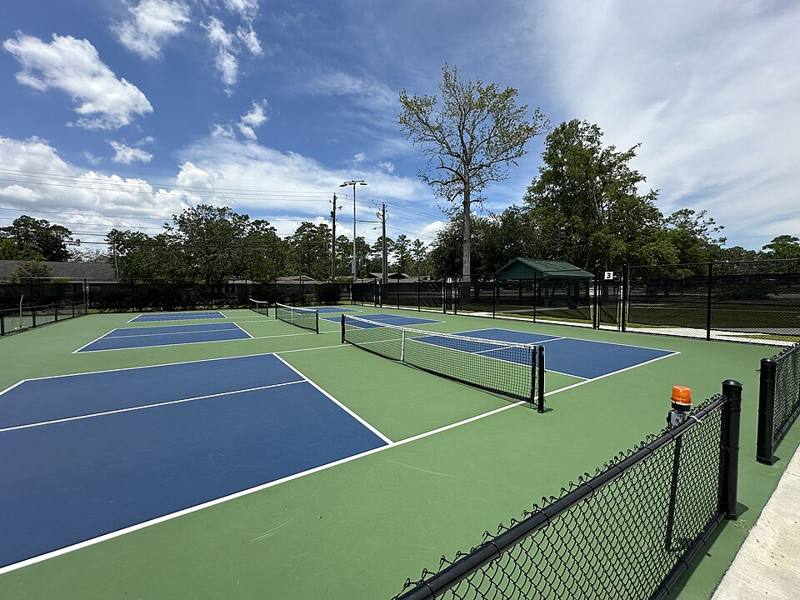
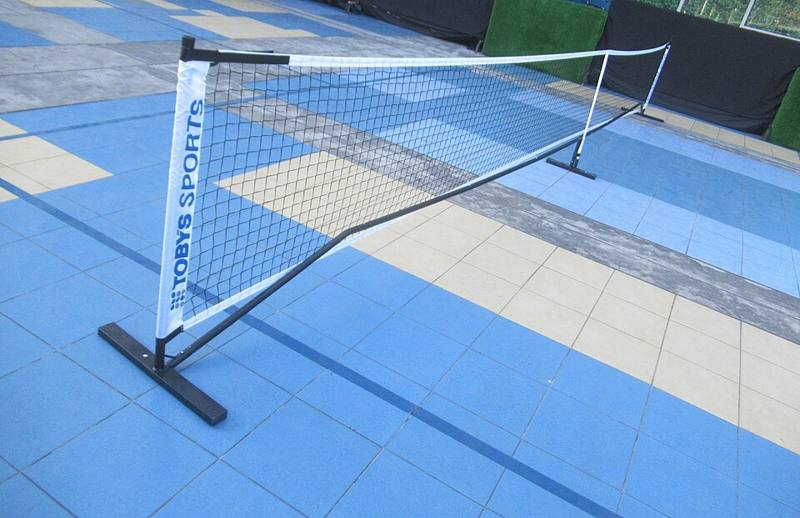
The net and the plane of the net
The net area causes more confusion than anything else. Separate it into three ideas.
The ball must reach your side first
A ball must completely cross the plane of the net to your side before you hit it. Reaching over the net to hit a ball that is still on the opponent's side is a fault. This shows up most often on dinks that pop up near the net: wait until the ball crosses, then attack.
You may follow through over the net
Once you have hit the ball, your paddle and body may cross the plane of the net as part of that same stroke and its natural follow-through. What you may not do is cross before you hit the ball, or cross without hitting it at all.
There is one special case. If the ball bounces on your side and then spins or blows back over the net without being touched, you may cross over, under or around the net to play it, but only after the ball has crossed back to the opponent's side. If you fail to hit it before it bounces on their side, it is a fault.
Do not touch the net or the opponent's court
While the ball is live, you and anything you wear or carry must not touch:
- The net, the net posts or any part of the net support system.
- Your opponent, or the opponent's end of the court.
Touching the net with your paddle on a follow-through while the ball is still in play is a fault, even if your shot was a winner. Once the ball is dead, touching the net is not a fault.
Around the post, not under or through
A ball may legally travel around the outside of the net post, even if it never goes over the net. That is the basis of the around-the-post shot. A ball hit under the net, or between the net and the net post, is a fault.
Quick reference
| Situation | Call |
|---|---|
| Ball hits your paddle hand below the wrist while gripping the paddle | Legal, play on |
| Ball hits your forearm, wrist or free hand | Fault on you |
| Opponent's ball hits you while you stand out of bounds | Fault on you |
| Serve hits the receiver's partner before landing | Fault on the receiving team |
| Double contact within one continuous stroke | Legal |
| Two separate hits by one player, or hits by both partners | Fault |
| Paddle crosses the net after contact as part of the stroke | Legal |
| Paddle reaches over the net before contact | Fault |
| Paddle touches the net while the ball is live | Fault |
| Ball goes around the net post and lands in | Legal |
Drills that build clean habits
- The duck drill. A partner feeds high, deep balls that are going out. Your job is to recognize them and move your body out of the way rather than blocking them.
- Pop-up patience. At the kitchen, a partner feeds soft balls that land just over the net. Attack only after the ball has crossed, and finish your swing without touching the net.
- Hand check. In volley drills, notice where mishits land. Balls off the fingers are fine. Balls off the forearm are a reminder to keep the paddle out in front.