Learn / Official rules explained
The kitchen (non-volley zone) rules
You can stand in the kitchen any time, but you cannot volley while touching it, including the line, and momentum from a volley cannot carry you in. Here is every kitchen rule with examples.
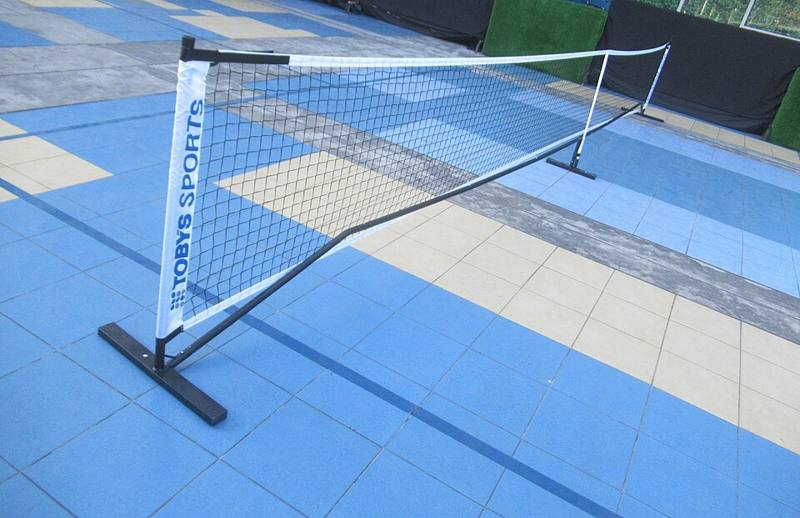
What the kitchen is
The non-volley zone, almost always called the kitchen, is the area within 7 feet of the net on both sides, stretching from sideline to sideline. The kitchen line belongs to the kitchen. The zone also extends upward, in the sense that the rules care about what you are touching when you volley, not just where the ball is.
The kitchen exists to stop players from standing on top of the net and smashing every ball. It is what makes the soft game of dinks possible.
The core rule
You may not volley the ball while touching the kitchen. A volley is any shot hit before the ball bounces. "Touching the kitchen" includes:
- Standing in the kitchen or on the kitchen line.
- Touching it with any part of your body, your clothing or your paddle.
It does not matter whether the ball is over the kitchen. What matters is where you are.
You CAN be in the kitchen
This is the most common misunderstanding. The kitchen is not off-limits. You may:
- Walk into it at any time.
- Stand in it as long as you like.
- Step in to hit a ball that has bounced. In fact, stepping in to play a short dink after the bounce is normal.
The only thing you cannot do from in the kitchen is volley.
Getting out before you volley
If you are in the kitchen, you must re-establish both feet on the court outside the kitchen before you can volley. Hopping out on one foot and volleying is a fault. A useful habit is to step in for a bounced ball and immediately step back behind the line.
The momentum rule
A volley is a fault if the momentum of the volleying action carries you into the kitchen, even after the ball is dead. Examples:
- You volley at the line, the rally ends, and you stumble forward onto the kitchen line. Fault.
- You volley, then your paddle falls into the kitchen. Fault.
- Your hat falls off into the kitchen during a volley. Fault, because worn and carried items count.
The act of volleying includes the swing, the follow-through and the recovery of your balance.
Legal ways around the kitchen
Two advanced shots exploit the kitchen rules legally:
- The erne: a player jumps over the corner of the kitchen, or moves outside the sideline past the kitchen, to volley near the net without touching the zone. See the erne.
- Volleying right at the line: your toes can be an inch behind the line. Lean, reach and extend, but do not touch.
Kitchen faults at a glance
| Situation | Call |
|---|---|
| Volley with a foot on the kitchen line | Fault |
| Step in, play a bounced ball, step back | Legal |
| Volley, then momentum carries you in | Fault |
| Volley while standing in the kitchen | Fault |
| Volley after re-establishing both feet outside | Legal |
| Jump from outside, volley in the air, land outside | Legal |
| Jump from outside, volley, land in the kitchen | Fault |
Who calls it
In recreational play, each player is responsible for calling their own kitchen faults, and opponents can call faults they see. In sanctioned matches with a referee, the referee makes the call. Honest self-calling is part of pickleball culture. See line calls.
Kitchen habits that help
- Set your feet a few inches behind the line, not on it.
- Bend your knees and stay balanced, so you never fall forward after a volley.
- Practice the "step in, step out" pattern in dink drills.
- When you are pulled wide, think about the erne or a smart reset.
"You can never go in the kitchen." Fact: You can go in any time. You just cannot volley while touching it.