Nets and home courts
The official court and net measurements, how to set up a portable net, how to mark a court on a driveway or other space, and what to know about playing surfaces. Every number checked against the USA Pickleball rulebook.
The official numbers
These measurements come from the 2026 USA Pickleball Official Rulebook. A home court does not have to be perfect, but matching these numbers means your practice translates directly to regular courts.
Court
| Item | Measurement |
|---|---|
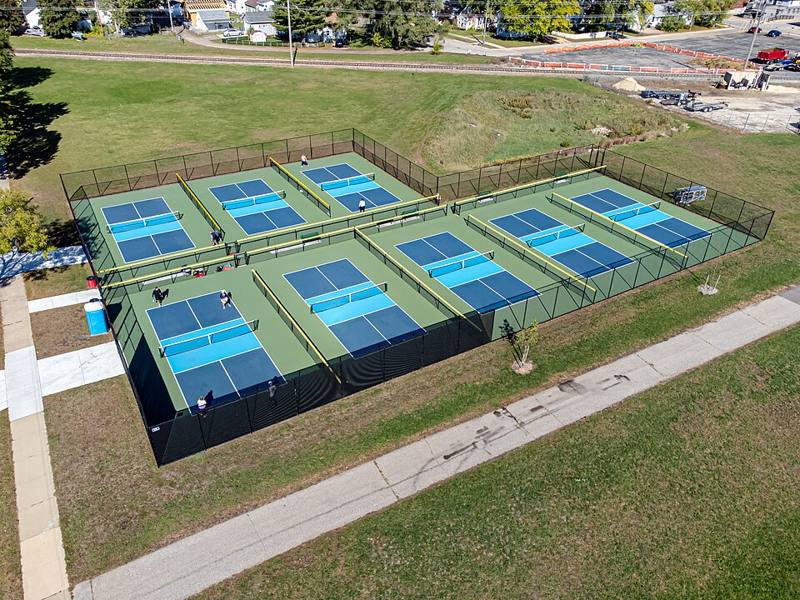
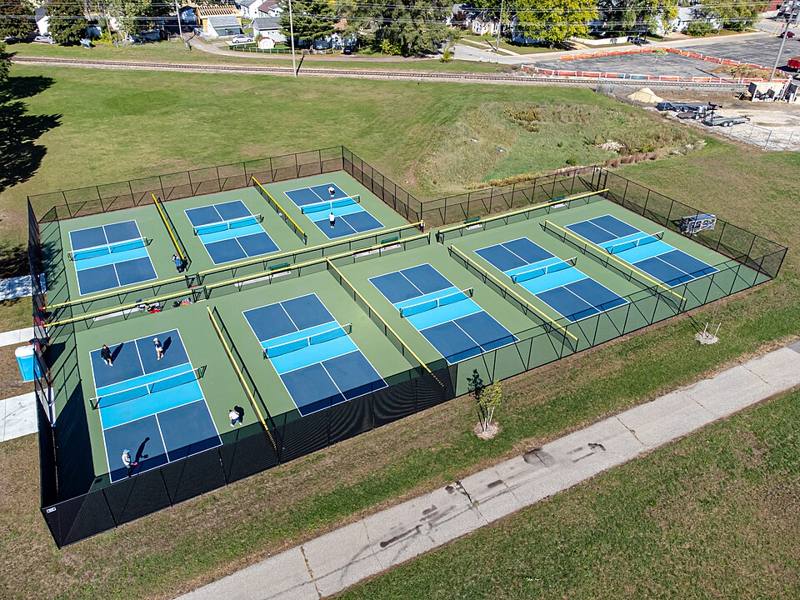
| Court size | 20 ft wide by 44 ft long (same for singles and doubles) |
| Non-volley zone (kitchen) | 7 ft deep on each side of the net, 20 ft wide |
| Line width | 2 in, all lines the same color, contrasting with the surface |
| How to measure | To the outside edge of the perimeter and kitchen lines |
| Minimum total playing surface | 30 ft wide by 60 ft long |
| Recommended for new construction | 34 ft wide by 64 ft long |
Net
| Item | Measurement |
|---|---|
| Height at the sidelines | 36 in (plus or minus 0.25 in) |
| Height at the center | 34 in (plus or minus 0.25 in) |
| Post spacing | 22 ft (plus or minus 1 in), inside of one post to inside of the other |
| Maximum post diameter | 3 in |
| Net length | At least 21 ft 9 in, post to post |
| Net depth (bottom edge to top) | At least 30 in |
| Top edge | 2 in white tape binding over a cord or cable |
| Center strap | Optional, centered 10 ft from the outside edge of the sidelines |
Because the sideline lines are part of the 20-foot court, posts set 22 feet apart sit outside the court on each side.
Portable nets
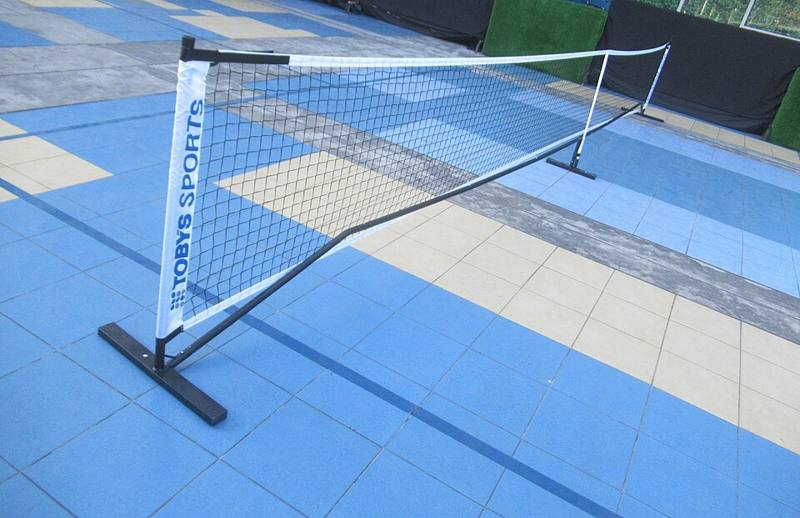
A portable net is the easiest way to play at home, in a park or on a converted tennis or basketball court.
What to look for
- Regulation width. Look for a net system designed for a full 20-foot court with posts at about 22 feet apart. Shorter nets exist for kids or small spaces, but they change the game.
- Height adjustment that lets you reach 36 inches at the sidelines and 34 inches at the center.
- A stable base that does not tip when the ball hits the net or when the wind blows.
- A carry bag and a frame that is easy to assemble.
- Durable netting that does not let a ball pass through.
How to set it up
- Place the net at the midpoint of your court, 22 feet from each baseline.
- Center it so the posts sit equally outside each sideline.
- Tension the net so the top is level and the center dip is even.
- Measure the height with a tape measure: 36 inches at each sideline, 34 inches at the center.
- Recheck the height after a few games. Portable nets can sag over time.
Make a quick height gauge. Mark 34 and 36 inches on a stick or a spare piece of wood and keep it with your net.
Planning a home court
Find your space
A full court needs 20 by 44 feet for the lines alone. The rulebook's minimum playing surface is 30 by 60 feet, which gives room to move behind the baselines and beside the sidelines. A smaller space can still work for practice.
Measure your area before you buy anything. Look for:
- A flat, smooth surface without large cracks or slopes.
- Enough space behind each baseline to move back for deep balls and lobs.
- Clearance from hazards such as cars, walls, poles, landscaping and streets.
- Neighbor considerations. Pickleball can be loud. Check local rules, neighborhood or homeowner association rules, and noise guidelines before building a permanent court.
Driveway and small-space layouts
Driveways come in many sizes, so measure yours. Common options:
| Your space | Option |
|---|---|
| At least 20 by 44 ft, with room around it | Full regulation court with a portable net |
| Narrower than 20 ft | Skinny singles on a half-width court, using the centerline as a sideline |
| Shorter than 44 ft | Kitchen-only play: just the net and both 7-ft kitchens for dinking and volleys (14 ft from kitchen line to kitchen line) |
| Very small or along a wall | Wall drills with a tape line at net height |
Kitchen-only and half-court setups are great for practicing dinks, resets and volleys. See practice drills.
Never play on a driveway that opens onto a street without a way to stop balls and players from running into traffic.
Marking lines
For temporary lines:
- Sidewalk chalk works on concrete and asphalt and washes off.
- Painter's tape or court marking tape gives straighter lines. Test it on a small area first to make sure it peels cleanly.
- Rubber throw-down lines are reusable and quick to lay out.
For permanent lines, use court paint made for your surface.
Getting the layout square
- Mark the baseline, 20 feet long.
- Measure 44 feet down each side for the sidelines.
- Check the diagonals. On a true rectangle, the two corner-to-corner measurements are equal. A 20 by 44 foot rectangle has a diagonal of about 48 feet 4 inches.
- Mark the kitchen lines 7 feet from the net on each side.
- Mark the centerlines from each kitchen line to its baseline, splitting each side into two 10-foot-wide service courts.
Measure to the outside edge of the lines, as the rulebook describes.
Playing surfaces
| Surface | Notes |
|---|---|
| Acrylic-coated concrete or asphalt | The typical outdoor court surface; consistent bounce and grip |
| Bare concrete | Common for driveways; bounce is fine, but it can be slick when dusty or wet, and it is harder on joints |
| Bare asphalt | Common for driveways; it gets hot in the sun and can be rough on balls and shoes |
| Gym floors | Common indoors; use indoor balls and non-marking court shoes |
| Sport tiles | Modular tiles that snap together over a hard, flat base |
| Grass, gravel, sand | Not suitable for normal play; the ball will not bounce reliably |
Outdoor balls are made for hard outdoor surfaces, and indoor balls for gym floors. Read indoor vs. outdoor balls.
Keeping it safe and playable
- Sweep the surface before playing to remove grit, leaves and pebbles.
- Avoid wet surfaces. Many court surfaces are slippery when damp.
- Check the net height at the start of every session.
- Wear proper court shoes. See shoes.
- Store the net indoors or in its bag when not in use.