Court dimensions and lines
A pickleball court is 20 by 44 feet with a 7-foot non-volley zone on each side of a net that is 36 inches at the posts and 34 inches in the middle. Here is every line and what it does.
The numbers you need
| Part | Measurement |
|---|---|
| Court (lines included) | 20 feet wide x 44 feet long |
| Each half of the court | 20 x 22 feet |
| Non-volley zone (kitchen) | 7 feet deep from the net on each side, full width |
| Each service court | 10 feet wide x 15 feet deep |
| Line width | 2 inches |
| Net height at sidelines | 36 inches |
| Net height at center | 34 inches |
| Recommended total playing area | 30 x 60 feet, with 34 x 64 feet preferred for tournaments |
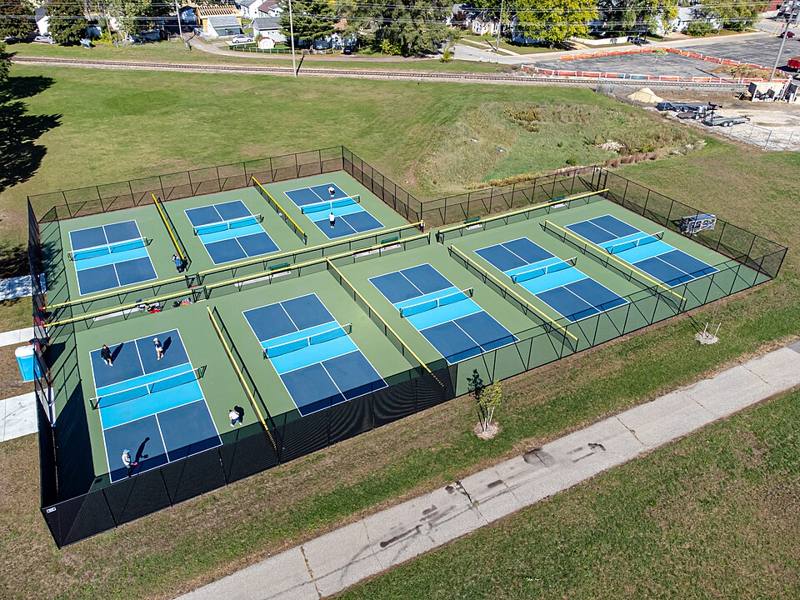
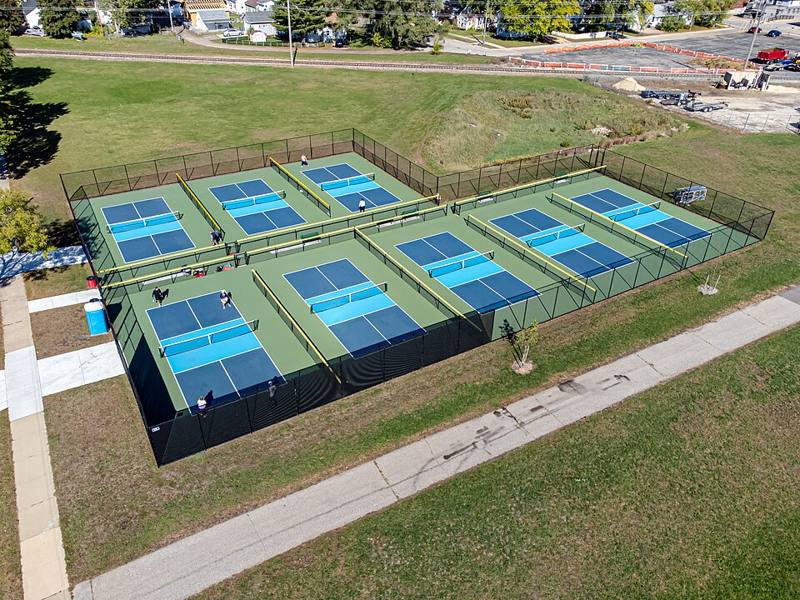
The court is the same size as a doubles badminton court. Four pickleball courts fit, with some adjustment, on one tennis court footprint, which is why many parks convert tennis courts.
The lines and what they mean
- Baseline: the back line at each end. The server must stand behind it.
- Sidelines: the long lines on the left and right.
- Non-volley line (kitchen line): 7 feet from the net. It belongs to the kitchen, so stepping on it while volleying is a fault. See the kitchen.
- Centerline: runs from the kitchen line to the baseline and splits each half into the right (even) and left (odd) service courts. There is no centerline inside the kitchen.
All lines are 2 inches wide and are part of the area they surround. A ball touching the baseline or sideline is in. On the serve, a ball touching the kitchen line is short and therefore a fault, because the kitchen line is part of the kitchen. More in line calls.
The net
The net hangs from posts placed outside the sidelines. It sags slightly, so it measures 36 inches at the sidelines and 34 inches at the center. That 2-inch difference matters: shots over the middle clear more easily, which is one reason crosscourt dinks are so common.
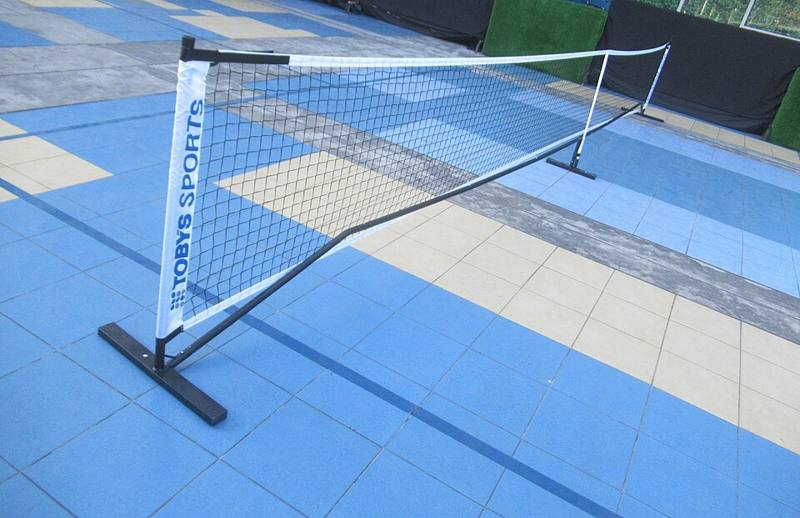
Portable nets are popular for driveways and gyms. Most fold into a carry bag and set up in a few minutes. Check the center height with a tape measure, because many portable nets need the center strap adjusted.
Indoor, outdoor and shared courts
| Surface | What to expect |
|---|---|
| Dedicated outdoor hard court | Acrylic-coated asphalt or concrete, consistent bounce, permanent nets |
| Tennis court with pickleball lines | Lines in a different color overlap tennis lines, sometimes confusing at first |
| Indoor gym | Lines taped or painted over basketball lines, faster and lower ball bounce, uses indoor balls |
On a shared tennis court, train your eyes to ignore the tennis lines. A useful habit is to look at the corners of the kitchen before the first serve to fix the right lines in your mind.
Setting up your own court
If you want to tape a temporary court in a driveway or gym:
- Mark a 20 x 44 foot rectangle. Check that the diagonals are equal (about 48 feet 4 inches) so the corners are square.
- Mark the net line across the middle at 22 feet.
- Mark the kitchen lines 7 feet from the net on each side.
- Mark the centerlines from each kitchen line to its baseline.
- Use 2-inch tape and set the net to 36 inches at the sides, 34 inches at center.
Leave room behind the baselines. Players back up for lobs, and a wall or fence too close is a common cause of falls. See common injuries.
Where you stand
In doubles, at the start of each point the server stands behind the baseline, the server's partner usually stands back too, the receiver stands near the baseline and the receiver's partner often starts at the kitchen line. Why? Because of the two-bounce rule. Doubles positioning explains it fully.