Equipment basics for new players
All you need is a paddle, the right ball, court shoes and ideally eye protection. Here is what the rules allow and what to look for on a beginner budget.
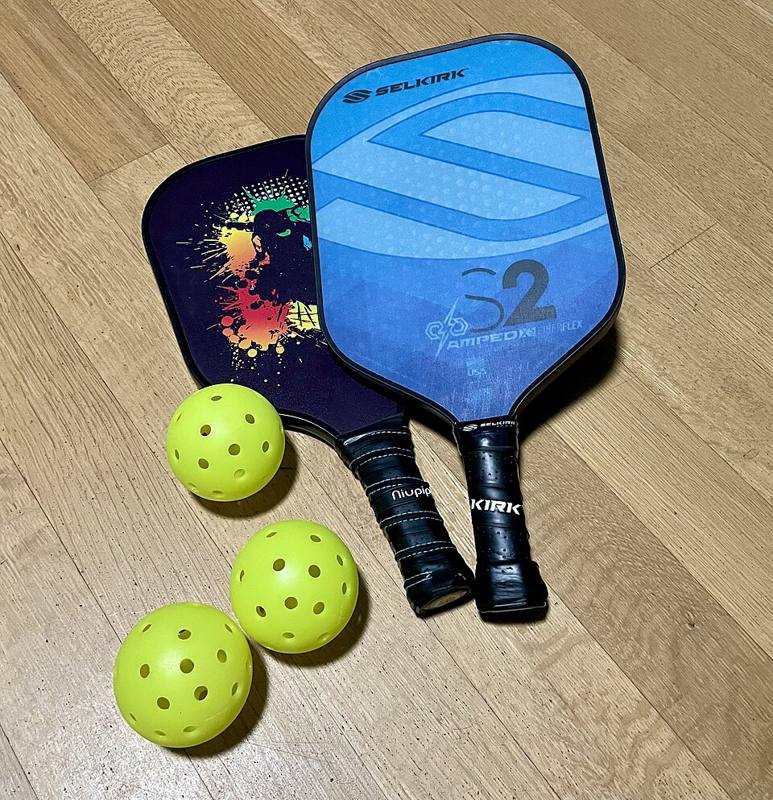
The paddle
A pickleball paddle is a solid face with no strings. The official specifications are simple:
- The length plus width must not exceed 24 inches.
- The length must not exceed 17 inches.
- There is no weight limit and no thickness limit.
- The surface must not be textured beyond the allowed roughness, and no moving parts, springs or added materials that change the hit are allowed.
For sanctioned tournaments, your paddle must be on USA Pickleball's approved equipment list. For recreational play any paddle works.
Most beginners do well with a mid-weight paddle (roughly 7.5 to 8.2 ounces), a standard shape and a polymer honeycomb core. That combination is forgiving and comfortable. When you want to learn more, read paddle materials, weight and shape and grip size.
Wooden paddles are cheap and durable but heavy and dead-feeling. They are fine for a first try, but most players upgrade within a few weeks.
The ball
Pickleballs are hard plastic with round holes. The official specs call for a diameter between 2.87 and 2.97 inches and a weight between 0.78 and 0.935 ounces, with between 26 and 40 holes. Balls must bounce within a set range when dropped onto a hard surface.
There are two families:
| Type | Holes | Feel | Where |
|---|---|---|---|
| Outdoor | Usually around 40 smaller holes | Harder, heavier, faster, handles wind better | Outdoor hard courts |
| Indoor | Usually around 26 larger holes | Softer, lighter, slower, quieter | Gym floors |
Using an outdoor ball indoors makes it skid and fly; using an indoor ball outdoors makes it hard to control in the wind. Full details in indoor vs outdoor balls.
Shoes
Pickleball is mostly short sideways steps, quick stops and the occasional backpedal. Running shoes are built for forward motion and have soft, high heels that can roll over during lateral moves. Choose tennis or court shoes with a flat, wide sole and side support. Indoor players want non-marking gum soles. Read shoes.
Eye protection
The ball is hard and moves fast at the net, and eye injuries do happen. Sports glasses or protective eyewear with impact-resistant lenses are inexpensive insurance, especially for doubles players who spend a lot of time at the kitchen line.
Nice-to-haves
- Overgrip: a thin wrap over the paddle grip that adds tack and a little thickness. Cheap and easy to replace.
- Edge guard tape: protects the paddle edge from scrapes.
- Bag: a backpack with a paddle sleeve and a shoe compartment.
- Water bottle, hat, sunscreen: outdoor sessions run long.
- Portable net: if you want to play in a driveway or gym.
A simple starter budget
| Item | Approach |
|---|---|
| Paddle | One mid-weight composite or fiberglass paddle |
| Balls | A pack of outdoor or indoor balls to match your courts |
| Shoes | Court shoes you already own, or a pair of tennis shoes |
| Eyewear | Basic sports glasses |
Many players buy a beginner paddle set (two paddles and balls) first, then upgrade to a single better paddle after a month of play when they know what they like. Our paddle comparison tables make that second purchase easier.
Taking care of your gear
- Keep paddles out of hot cars. Heat can damage the core and the face bonding.
- Wipe the face with a damp cloth to remove dirt so it keeps its grip on the ball.
- Retire cracked balls. Outdoor balls crack more in cold weather.
- Replace overgrips when they get slick, which can be every few weeks for frequent players.